This blog post is converted from a Dora Ventures internal communication email thread on October 26th.
Since Anthropic's prospectus became public, the criticism has centered on several points: operating costs, forward compute commitments, accounting losses tied to the Amazon convertible notes, and the risk that revenue growth slows. These are real risks, but they mostly determine whether Anthropic survives to the long term, not what it is worth once it gets there. This post sets them aside and asks the second question.
Premise and implication
Premise: Anthropic survives its short- and medium-term debt obligations. If it does, nearly all the revenue it earns from consumers and enterprises in the near term is reinvested in training better models. Margins, cash flow, and even revenue growth then describe an intermediate state of a reinvestment engine, not the terminal value of the company.
Implication: model capability will eventually exceed what consumers and enterprises need. Consumer demand (answering questions, writing, coding) and enterprise demand (workflow automation, efficiency) have a ceiling. Model capability has no such ceiling and has been rising along an exponential curve. At some point the curve crosses the demand line, and beyond it a stronger model adds little marginal value for ordinary users, who only need "good enough".
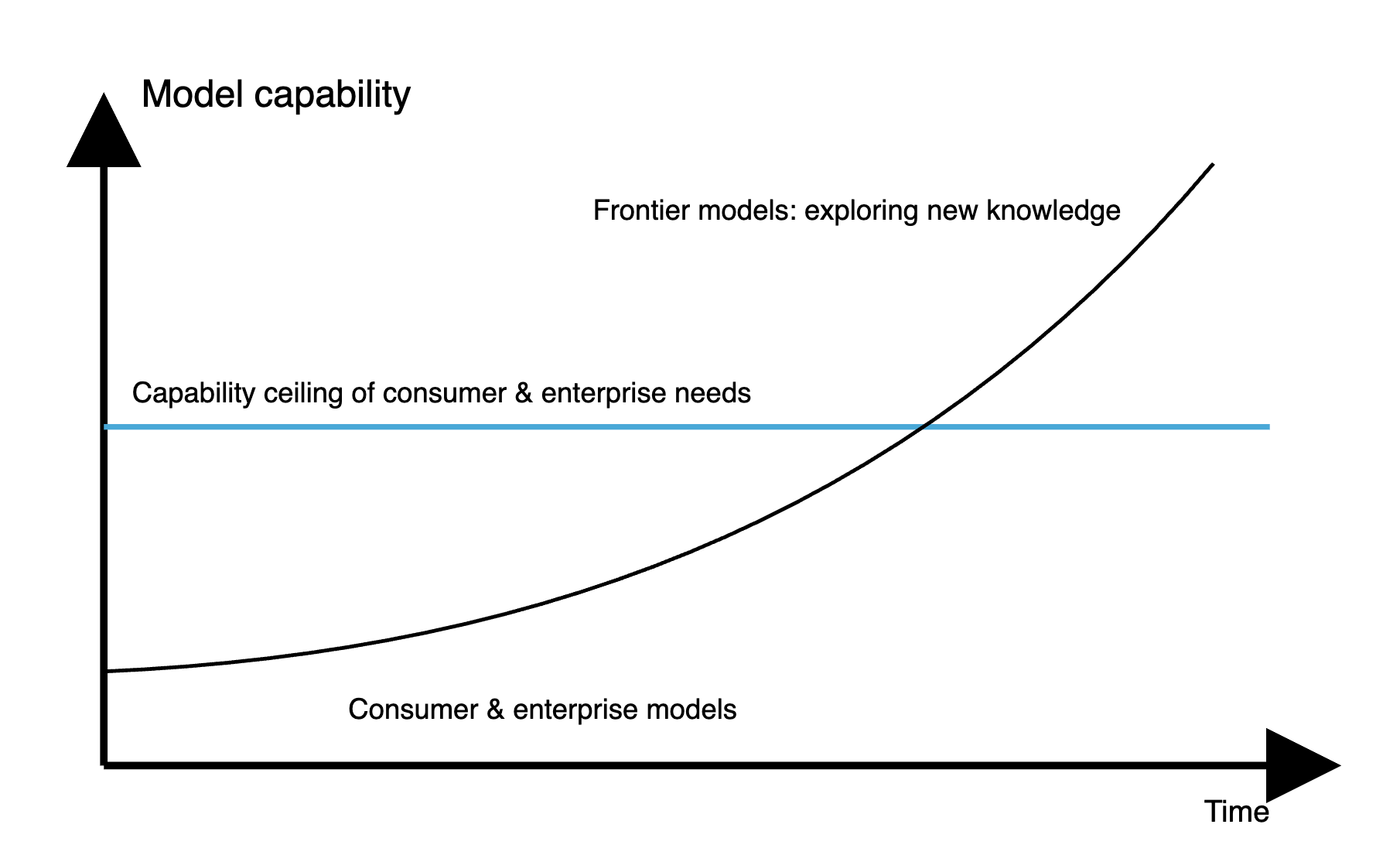
Figure 1. Frontier capability keeps rising, while consumer and enterprise needs plateau. Past the crossing point, additional capability is directed at exploring new knowledge.
That surplus capability does not go idle. It moves toward exploring new knowledge: new materials, drugs, physical theories, mathematical proofs. This value is substantive, because new knowledge accumulates and compounds as a lasting asset. Consumer and enterprise applications mostly draw on existing knowledge, so their value is non-substantive. Once the capability ceiling of the mass market is passed, the value of the first category dwarfs the second.
The expanding frontier
In this regime, human knowledge production becomes a small core inside a much larger region of AI-generated discovery. The boundary AI pushes outward could extend without limit beyond what humanity has found so far. The value created is hard to estimate directly, but its order of magnitude is not: it plausibly exceeds the sum of today's human productivity.
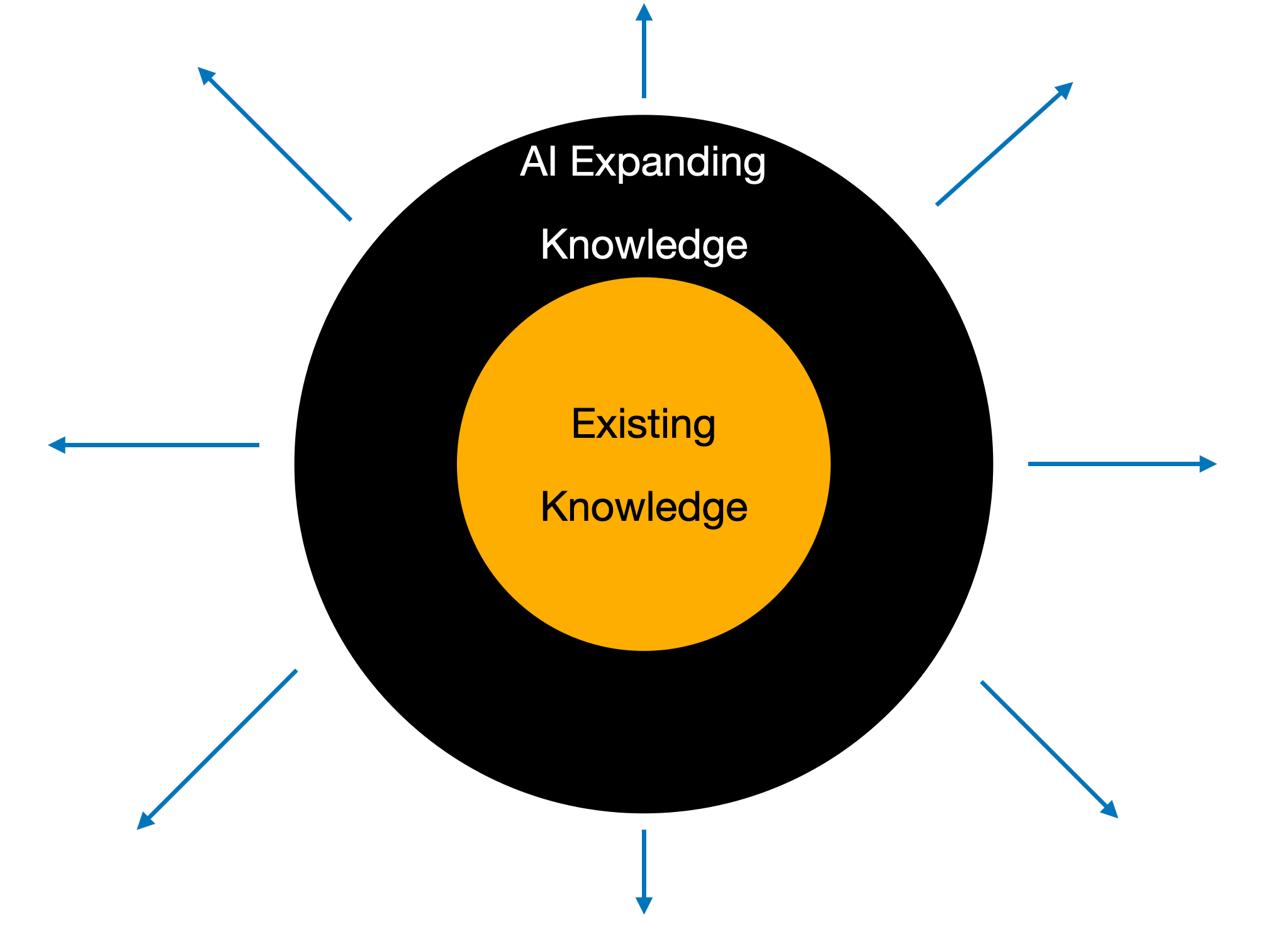
Figure 2. AI-expanded frontier that keeps growing outward.
Electricity, models, and knowledge
A more fundamental way to see this is that a model is a converter that turns electricity directly into knowledge.
The shortest known path from raw cosmic energy to intelligence needs only two converters:
- A stellar energy converter, which turns sunlight into electricity.
- A knowledge converter, which turns electricity into knowledge: a high-quality AI model.
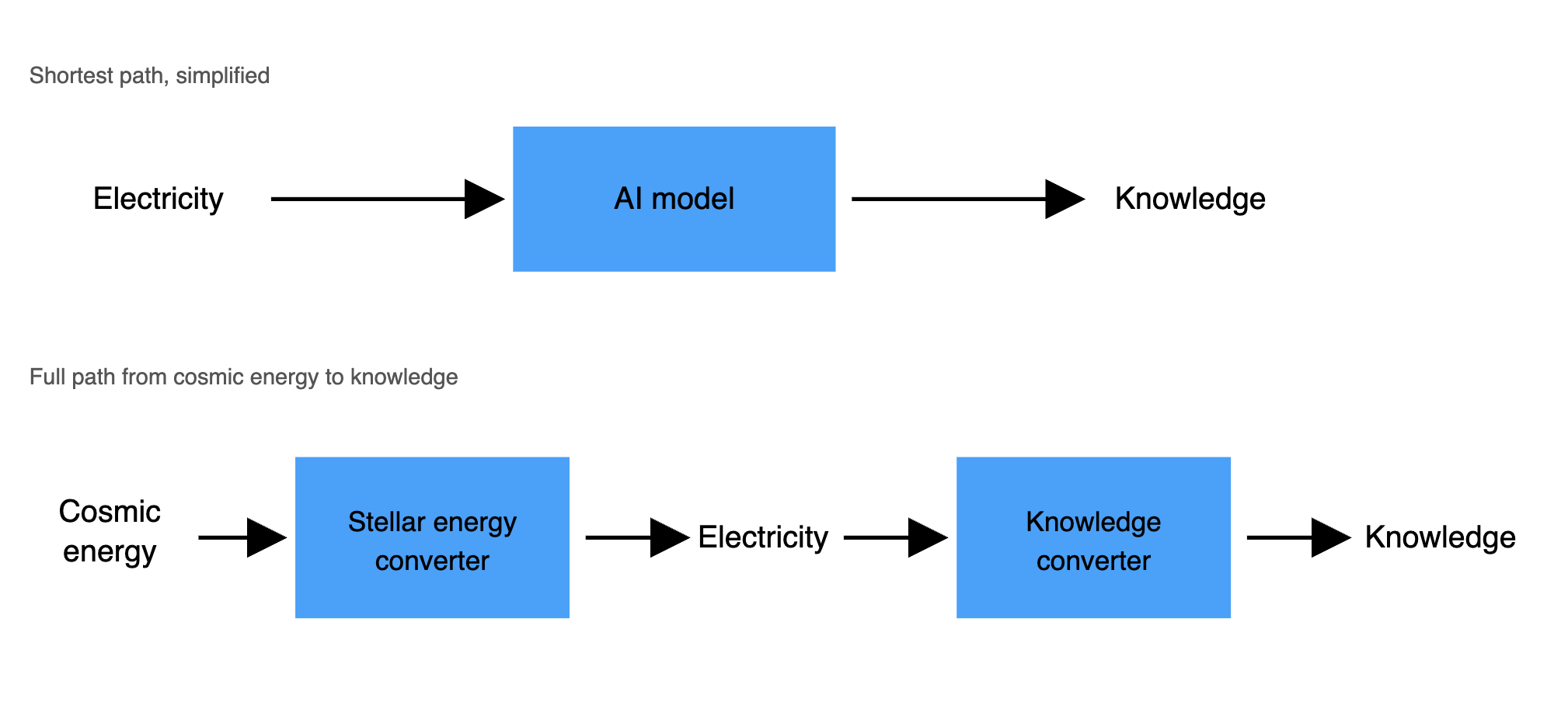
Figure 3. Two converters are all this path requires: one for stellar energy, one for knowledge.
Today SpaceX is arguably the best-positioned stellar energy converter, since its role is capturing and converting solar energy at scale, including in space. Anthropic and OpenAI build the highest-quality knowledge converters. On this view, Anthropic's long-term valuation is the value of a knowledge converter carrying the value of knowledge not yet discovered.
Where the argument needs more support
The framework only holds if several further conditions are met.
- Frontier leadership must compound. A converter is worth what its efficiency is worth, meaning how much useful knowledge it yields per unit of electricity. If capabilities converge and models become commodities, value shifts upstream to power and compute. The thesis therefore depends on lead at the frontier being cumulative and durable, which is also why reinvesting all revenue into research matters.
- Models are not the only bottleneck. Much new knowledge must be verified in the physical world: drugs need trials, materials need synthesis. Once models outrun demand, the constraint moves to experimentation, data, and validation. That sets the pace at which value is realized and makes this a long-horizon story.
- Value capture is unresolved. How much of the value of new knowledge returns to Anthropic, through partnerships, licensing, or in-house research, as opposed to spreading across society and users, has no proven business model. This is the largest uncertainty in the valuation.
- Survival gate. The premise of avoiding debt-driven failure is the entry condition of the whole argument. The near-term concerns are secondary only because they do not change the destination. They still decide whether the destination is reached.
Conclusion
In the short run, Anthropic is a software company with very large capital commitments, and financial metrics describe it well. In the long run, it may be infrastructure that converts electricity into knowledge, and only the value of undiscovered knowledge describes that. The gap between these two ways of valuing the company is the source of today's disagreement.
This is not investment advice.